

an edge case essay
Tranq Doesn't Kill You. It Won't Let You Die.
A Navy SEAL on a combat deployment has an 0.8% annual chance of dying. Right now, using street drugs in America carries a higher one than that. That comparison is true, it's brutal, and it still undersells what's actually happening — because the thing that's replaced dope isn't trying to kill you anymore. It's trying to keep you alive long enough to rot.
The Comparison That Still Undersells It
Special forces is about as dangerous as legal work gets in this country, and using drugs today is more dangerous than that. I stand by that comparison — I built the numbers on it myself. But I built those numbers off overdose deaths, and overdose deaths are the wrong instrument for what I actually watched happen to people I knew. Deaths measure one thing: whether a specific dose stopped a specific heart on a specific night. They don't measure what's happening to a population that's still breathing.
That distinction didn't matter as much when heroin was heroin. It matters enormously now, because the drug that's taken over the street supply doesn't kill the way heroin killed, doesn't get flagged the way heroin got flagged, and doesn't show up in a mortality table the way heroin showed up. It's called xylazine. Everybody on the street just calls it tranq. And I think it's the worst thing that's happened to this population yet — worse than fentanyl — and the death numbers don't show it, for reasons that turn out to be the whole story.
Fentanyl Was At Least Honest
Fentanyl is a real opioid. It hits the same receptors heroin hits, which means it does the same thing heroin does, just faster and at a fraction of the dose — and it means naloxone reverses it. A bystander with a $40 nasal spray can pull someone back from a fentanyl overdose in the time it takes an ambulance to arrive. That's not a small thing. It's the difference between a drug that kills you and a drug that can kill you, on a night when nobody's watching.
Go back further and the population using it looked different too. Before fentanyl, before tranq, most people using heroin weren't the person you picture when you picture "heroin addict." They held jobs. They paid rent. They kept a lot of their lives running while an addiction ran underneath it — a shadow economy of people functional enough to stay hidden. Functional-to-nonfunctional isn't a stat anybody tracks cleanly, but I watched it happen in real time, in real people, over a few real years: people who were holding it together completely stopped holding it together. I want to be straight about what's data and what's me, because both matter here, and they're not the same thing.
Then It Stopped Being Dope
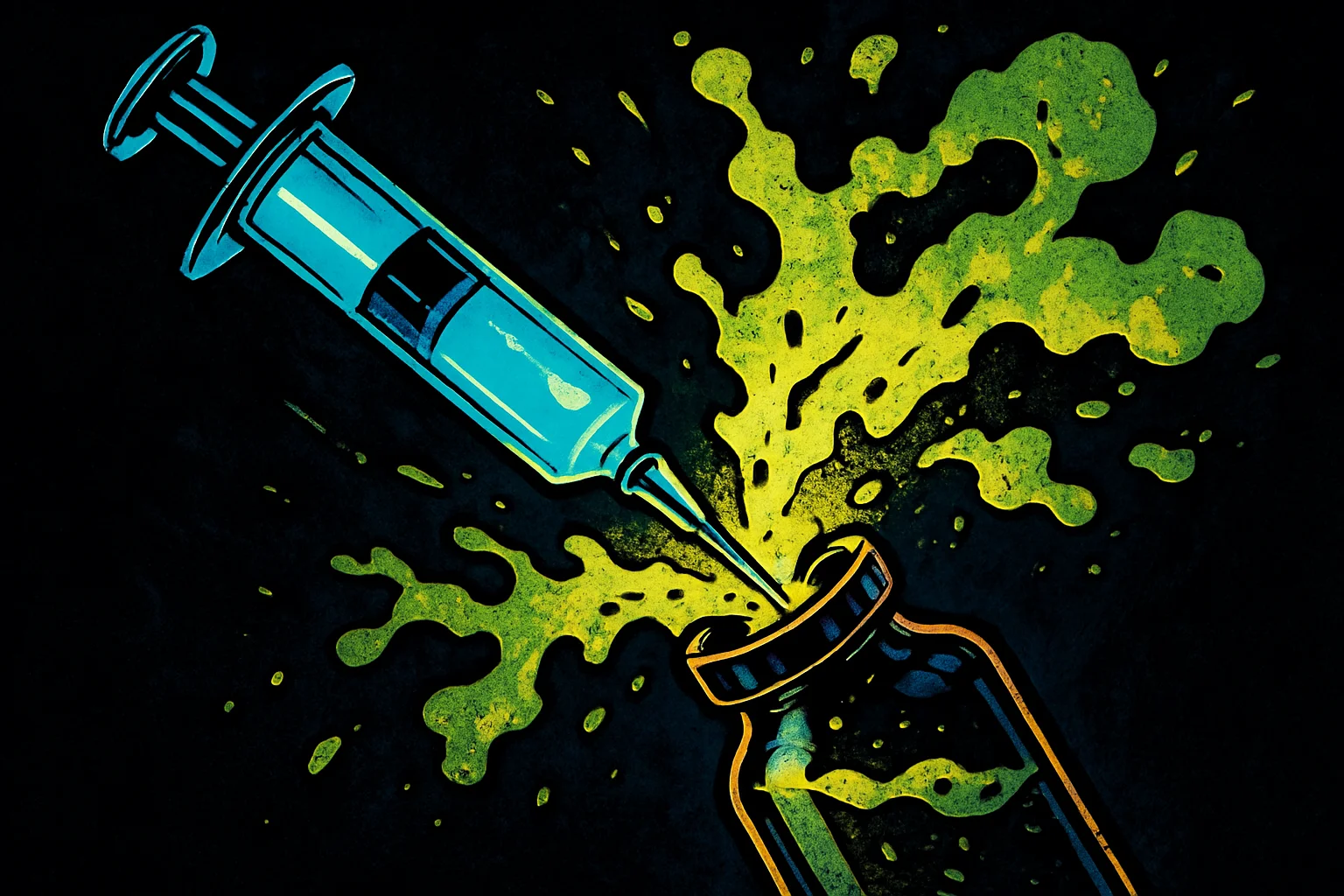
Xylazine is a veterinary sedative — an animal tranquilizer, not a human drug, and not an opioid at all. It's what's called an alpha-2 agonist: a completely different mechanism, which means naloxone does almost nothing to it. It got cut into the fentanyl supply because it's cheap and it stretches a high, and it spread fast: the DEA found it in 25% of seized fentanyl powder in 2022, 30% in 2023, and by October 2024 it had turned up in DEA-analyzed evidence in 49 of 50 states. Pennsylvania hit over 90% of tested fentanyl samples back in 2021. This isn't an emerging contaminant anymore. It's the base condition of the supply.
And it doesn't stay in opioids. It shows up cut into cocaine and crack too, specifically to knock down the stimulant edge and stretch the product — a documented pattern in drug-checking data, not a rumor. You don't have to be a heroin user to end up with tranq in your system. You just have to be buying from the same supply everyone else is buying from, because at this point that's the only supply there is.
The Death Count Is Lying to You
Here's the part that made me go looking for the numbers in the first place: there's no dedicated code for xylazine in the system that tracks cause of death in this country. Death certificates get coded with ICD-10, and xylazine doesn't have its own entry — it gets folded into a proxy code shared with an unrelated seizure medication. When CDC checked that proxy code against a manual read of actual death-certificate text in 2021, the code caught 2,657 xylazine-involved deaths. The real number, read by hand, was 3,468. The standard tracking method was missing almost a quarter of the deaths it was supposed to be counting — and that's the best-case scenario, in a case where xylazine was tested for and detected at all. A lot of jurisdictions don't routinely test for it.
Even the numbers that do get counted tell a story of undercounting by mechanism, not just by clerical gap. One ten-city study found xylazine detected in under 1% of overdose deaths in 2015 and nearly 7% by 2020. National data on fentanyl deaths with xylazine detected went from 2.9% in January 2019 to 10.9% by June 2022 — a 276% increase, with the age-adjusted xylazine death rate climbing 35-fold in three years. Those are real, ugly numbers. They're also still small next to fentanyl's own death toll, and that gap is exactly my point: most of what xylazine is doing to people was never going to register as an overdose, because overdose isn't the mechanism. Sepsis is. Endocarditis is. A wound nobody treated in time is. Those get written on a death certificate as sepsis, as endocarditis, as a body found in a condition too far gone to reconstruct — and xylazine is nowhere on that certificate, even when it's the reason the wound existed in the first place.
What It Actually Does
Xylazine kills tissue directly. Inject it and it causes cell death right where it lands — not from a dirty needle, from the chemical itself — plus vasoconstriction that starves surrounding tissue of blood, plus the kind of prolonged unconsciousness that leaves a person lying in one position long enough to develop a pressure ulcer on top of everything else. Clinicians in Philadelphia started seeing wounds in 2019 that didn't match anything already in the books — black, tunneling, dead tissue instead of ordinary infection — and by now the pattern is common enough that hand surgeons have published an actual staging system just for xylazine wounds, graded by whether the hand still has usable function or whether it's past that point. That's not a new treatment protocol for an old injury. That's a new category of injury, four years old, with its own name: tranq burn.
Between 2020 and 2023, roughly 450 people were hospitalized in Philadelphia with an opioid use disorder and underwent an amputation during that same stay — about two-thirds of them with a soft tissue infection on top of it — and the trend line tracks almost exactly with xylazine's growing share of the local supply. You don't have to inject it to get hurt, either. People who only smoke it report little to no wounding; people who snort it report damage to the nasal tissue; but harm-reduction nurses are documenting tranq burn even in people who never touched a needle. Injection is still the worst route. It's no longer the only one.
The Zombie Isn't a Metaphor
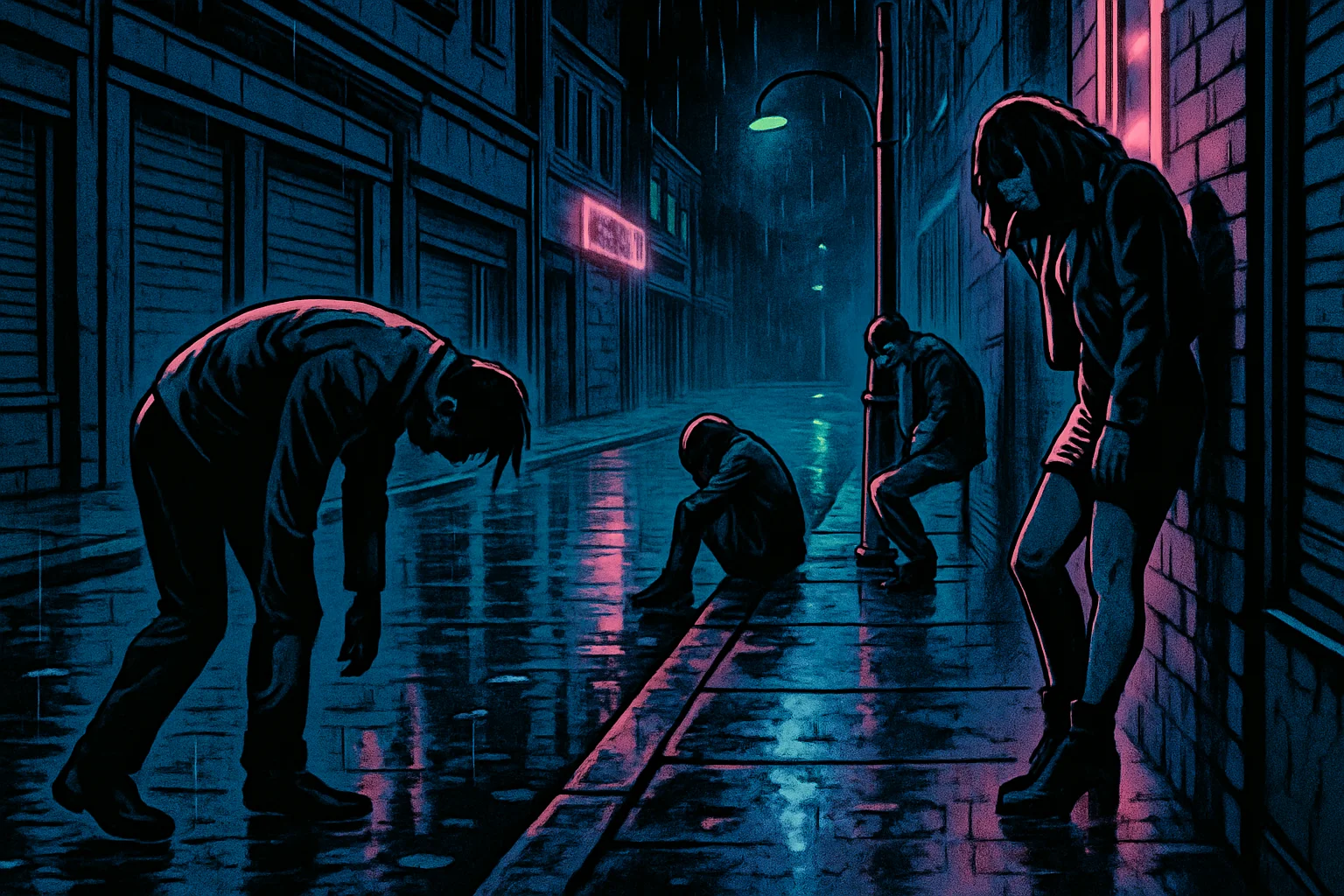
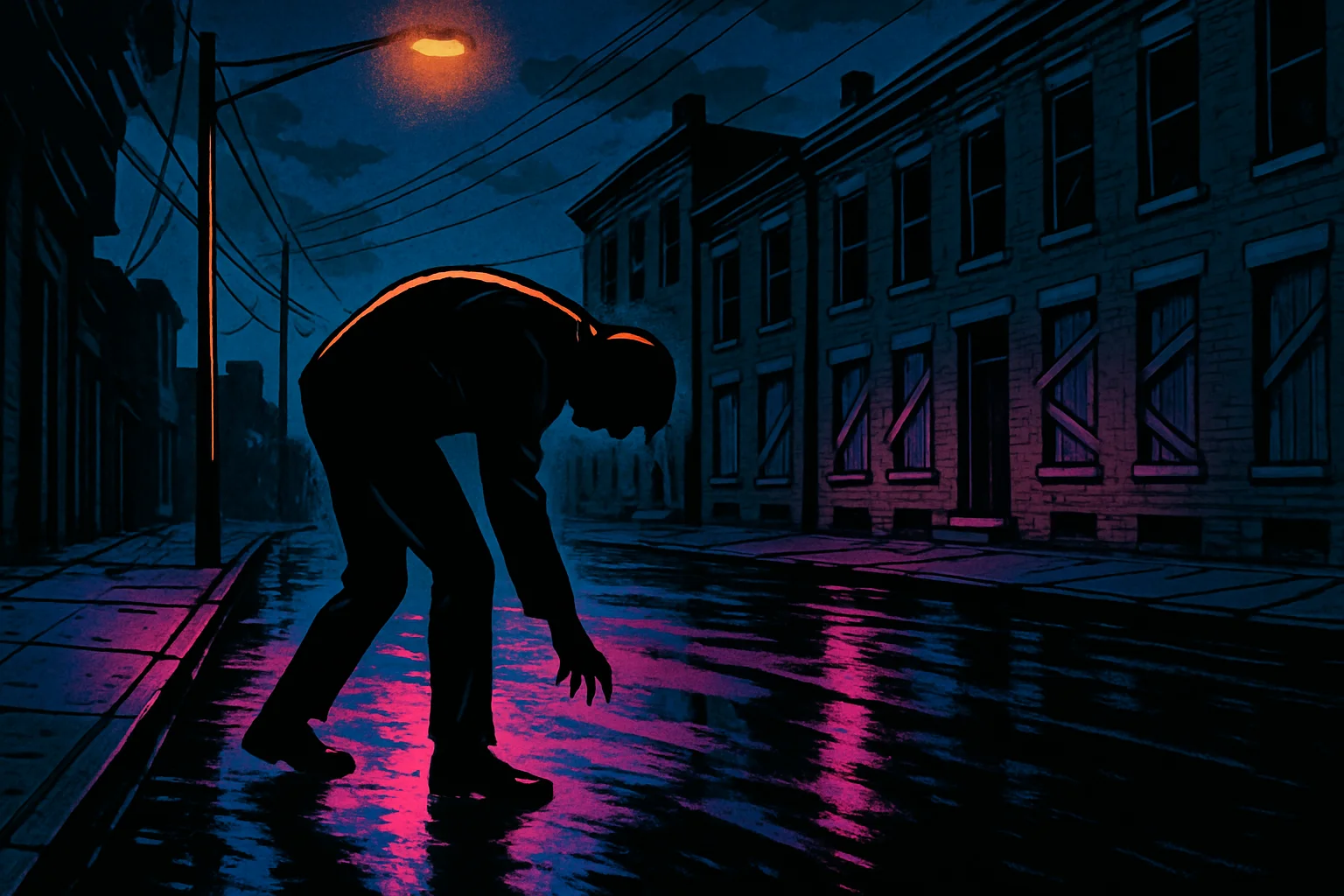
I've watched people stand bent double at the waist, motionless, like they're frozen mid-search for something on the ground, sedated but still upright. I've watched people shuffle a half-block that should take ten seconds. Clinicians and journalists covering Philadelphia use almost exactly that language — hunched over, bent at the waist, sedated but standing, others barely able to walk — because it's the actual clinical picture, not a scare word somebody invented for a headline. "Zombie drug" is the accurate name, not the sensational one.
What I don't know — what nobody knows yet — is whether any of it comes back. There's no FDA-approved protocol for xylazine withdrawal and no published long-term data on whether the cognitive fog lifts, because xylazine has only been a dominant part of the supply for a few years. The acute effects are documented: confusion, memory loss, a kind of emotional flatness underneath the sedation. Whether that reverses once someone's clean is a question the research hasn't had time to answer. I'm not going to pretend I know the answer either. I just know what I saw, and it didn't look temporary.
What I Watched Happen
I lived around this population. I watched specific people go from holding it together to completely shot out — not gradually in the way addiction is supposed to grind someone down over a decade, but fast, in a way that tracked with when tranq took over the supply, not with how long they'd been using. An addicted woman who was still attractive enough to work the higher end of the trade — clients who weren't using, or barely using, paying a real price for something closer to a normal transaction — could hold that position for years under the old supply. She can't anymore. She can't stay clean enough, can't stay present enough, can't hold together the version of herself that commanded that price. So she drops to the bottom rung, where the clients are the ones with the least to lose and the disease burden is worst, because the bottom rung is the only one still open to someone who can't manage a normal appointment. That's not a statistic I can hand you a citation for. Nobody's published that study yet. But it's not just me saying it — it's what harm-reduction workers and outreach nurses in these same neighborhoods describe when you ask them what changed, and it lines up with something that is measured: the neighborhood at the center of this, Kensington in Philadelphia, now holds something like a third of that entire city's homeless population in one place. People aren't just getting addicted there. They're getting stranded there.
Most people don't die from tranq. They live inside it — unconscious or close to it for large parts of every day, unable to keep themselves clean, fed, sheltered, or safe, for years, in a way heroin didn't do to the same population at the same rate. That's not a smaller problem than the death toll. It might be the bigger one, and it's the one the mortality data was never built to see.
Nobody Signed Up for This
Every person who ever used heroin made a choice, even a bad one, even one made by an addicted brain that wasn't choosing freely anymore — heroin was the thing they went looking for. Nobody goes looking for tranq. It arrives uninvited, cut into whatever they thought they were buying, with no label and no way to opt out. That's a different kind of injury than addiction usually is. It's not a person losing a fight they entered. It's a person having a completely different fight forced onto them while they thought they were still in the first one.
At least fentanyl killed fast and ended it. Tranq doesn't end anything. It manufactures more misery, for longer, in more people, and calls it survival. If I didn't know better, I'd think somebody designed it to cull a population instead of just getting them high. I don't think that's literally true. I think it's worse than that — nobody designed this on purpose, it's just what falls out when the cheapest possible cut wins, and cruelty this efficient doesn't need an author to be real.
There's also a one-card version of this if you just want the numbers to share. Related: Stop Copping. Start Cooking. — where I said going from a chatbot to your own terminal is like turning cocaine into crack, minus the bid and minus selling yourself. That line was a joke about AI. This is the thing it was actually a joke about, and there's nothing funny standing this close to it.
— The Edge Case
Sources
- DEA — Statement on the increase in fentanyl seizures containing xylazine
- CDC MMWR — Illicitly Manufactured Fentanyl-Involved Overdose Deaths with Detected Xylazine, January 2019-June 2022
- Assessing an ICD-10 Code Approach for Tracking Xylazine-Involved Overdose Deaths in the United States
- Amputation trends among people who use drugs in Philadelphia's increasingly xylazine-adulterated drug supply
- Xylazine-Associated Wounds of the Upper Extremity: Evaluation and Algorithmic Surgical Strategy — Journal of Hand Surgery Global Online
- KFF Health News — As opioids mixed with animal tranquilizers arrive in Kensington
- CNN — Tranq has become a bigger part of Philly's street fentanyl supply
- The xylazine-fentanyl nexus: A public health emergency