

an edge case essay
You Know How I Am
I told my girlfriend I will only wash the dishes. That sounds like a dick thing to say, and the fact that I had to sit and think about whether it was might be the more interesting problem. Every boundary you set takes something off someone else's menu. The question is never whether you're applying pressure. You are. The question is who ends up paying for it.

I Will Only Wash the Dishes
That's the whole sentence. I said it out loud in my own kitchen and I meant it, and I still think it's defensible. Here's what I meant by it: I'm happy to help with anything if you ask nicely. I'm reinforcing the version of this that works for both of us. I'm drawing a line between what I'll do freely and what I'll do only when I'm treated like a person while being asked.
Except even typing that out, I can hear exactly how it lands mid-argument. Controlling. Petty. The kind of line that reads less like a limit and more like a punishment with better grammar. "Ask nicely" is a reasonable request when everyone's calm and an incendiary device when they're not.
So I rewrote it in my head four times before I ever said it. Which is the part I keep circling back to.
If stating a limit out loud requires four drafts and a risk assessment, the limit isn't the problem. The room is.
That's not a gotcha aimed at anybody. It's a diagnostic, and it points in both directions. If you can't say a plain thing plainly, either you're not saying a plain thing, or you're not in a place where plain things are safe to say. Both are worth knowing. Neither is comfortable.
The Line Nobody Can Actually Draw
There's supposed to be a clean distinction between a healthy boundary and manipulation. An entire industry sells you the location of that line on a laminated card. Boundaries protect your peace. Manipulation controls other people. Clean, memorable, and useless the second you're standing in a kitchen at eleven at night.
In practice the line is a smear. Every boundary constrains somebody else's options. Every time you say "I won't do X unless Y," you are applying force. There is no version of setting a limit that doesn't move the other person. So the honest question was never am I exerting pressure — you are, always, the moment you stop being infinitely available.
The same sentence, two completely different machines
"I have a boundary around how I'm spoken to" can mean I've set a reasonable standard for not being screamed at. It can also mean I've built a rule that lets me disqualify any request I don't feel like honoring, by finding fault with the tone it arrived in.
The wording is identical. The mechanism is identical. What's different is who it costs, and that never shows up in the sentence.

Bubbles and Their Sponsors
Some people live in a bubble. They've built a small reality where their preferences have the standing of physical law and their quirks are everybody else's logistics problem. And nobody does that alone. It takes sponsors — a partner who absorbs the weather, friends who learn the route around the moods, and often enough money to keep consequences at arm's length.
If you bought your bubble outright, fine. Genuinely. You earned it, you're paying for it, and the terms are on the table. Hire people to handle what you can't stand doing. That's a transaction, and there's nothing wrong with a transaction where both sides know the price.
Most bubbles aren't bought. They're subsidized.
They're held up by people who can't afford to let go. The partner doing all the emotional labor while it gets described as "just how we work." The family that's been accommodating one person's dysfunction so long that nobody in it can describe what ordinary would look like. The bill still gets paid. It's just paid by whoever is underneath.
"You know how I am" is either a piece of self-knowledge or a bill you're sending to somebody who never agreed to pay it. Same five words.
Said one way it's an admission — I'm aware of this about myself, I'm telling you so you can plan around it, and I understand that's a favor you're doing me. Said the other way it's a wall with a smile painted on it: I see myself clearly, therefore you have to take all of it, and my clarity is now your obligation.
Self-awareness isn't a defense. Knowing exactly what you're doing to somebody and continuing to do it is not the redemption arc people seem to think it is. It's just a confession delivered with confidence.
The Manipulation You Can't See Coming
Here's what makes this genuinely hard rather than just uncomfortable: the most effective manipulation doesn't look like manipulation. It looks like vulnerability. It looks like somebody being brave about their needs.
I've done it. I've called something a boundary when it was just me being inflexible and wanting cover. I've said "this is what works for me" when the honest translation was "I'd rather not be inconvenienced by what works for you." The language of boundaries is perfect camouflage precisely because it's borrowed from something real. It sounds like self-respect. Sometimes it is. Sometimes it's a moat with a therapy vocabulary.
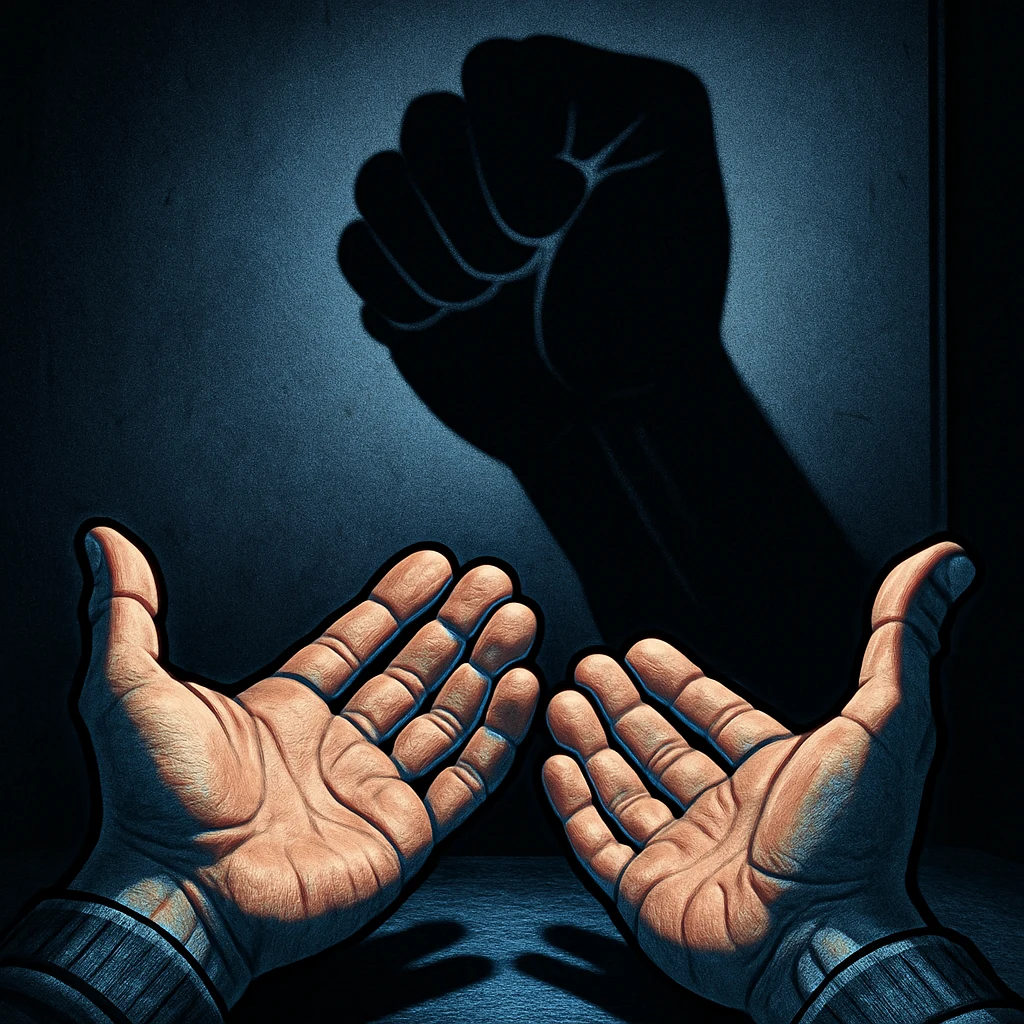
And you cannot audit this from inside your own head. That's the trap. Your internal narrator works for you and has never once returned an unfavorable verdict. I'm not being controlling, I'm being clear. I'm not being rigid, I'm being consistent. I'm not dodging, I'm protecting my peace. Every one of those might be true. Your own account of it is not evidence either way.
The Test You Won't Like
So if the sentence can't tell you and your own reasoning can't tell you, what's left is external data. Not how it felt to say. What it costs to live next to.
- Is it bilateral? A real boundary creates clarity both people can use. "I need a day's notice for plans" helps you both coordinate. A fake one creates a rule only one person benefits from and only one person has to follow.
- Who changes? Count how many of your limits require somebody else to modify their behavior while yours stays exactly where it is. If it's all of them, that's not a boundary system. That's a ratchet.
- How much eggshell is in the room? Not whether people say they're walking on them — they won't. How much of their day goes into anticipating your reaction. That's labor, it's unpaid, and you're the one who priced it.
- Does the friction go down over time? A working limit reduces conflict because everyone knows where the edges are. A fake one generates a steady supply of new conflicts, because it's not a limit, it's a lever.
If the people around you are doing more work to maintain your comfort than you're doing to maintain the relationship, you're not setting boundaries. You're exporting costs.
The Dishes and Everything Else
I still don't know about the dishes. Maybe it's a fair line. Maybe I was being a dick in a reasonable tone of voice. Maybe not being able to tell is the actual content of this piece, and the tidy answer I went looking for doesn't exist for anybody.
What I'm reasonably sure of: if I'm inside something somebody else is holding up, I don't get to call it self-care. If my particular way of being is a load, then "you know how I am" isn't insight. It's an invoice with no signature on the other side.
The line worth finding isn't between what you will and won't do. It's between what you're willing to impose and what you're still willing to negotiate. Between the comfort you demand and the discomfort you're willing to split.
You know how you are. The open question is whether everyone around you should have to know it too — and whether you ever asked them if that was okay.
Related: The Paperwork Exception — on how much of "acceptable" is the arrangement itself and how much is just the paperwork wrapped around it.
— The Edge Case
Sources
- DARVO: Deny, Attack, and Reverse Victim and Offender — Jennifer J. Freyd, University of Oregon. The formal name for manipulation that arrives dressed as injury.
- Coercive control — the pattern-based framing of control as an accumulation of individually-defensible rules rather than discrete incidents.
- Emotional labor — Arlie Hochschild's term for the unpaid work of managing feeling, which is what a subsidized bubble actually runs on.